
Synthetic Fuels and SAF
Solutions for the Social Implementation of Next-generation Fuels
Synthetic fuels are a collective term for fuels produced artificially from carbon dioxide (CO2) captured from the atmosphere or emitted by industrial sources, without relying on fossil resources. They are attracting attention as next-generation fuels that contribute to the realization of carbon-neutral society.The main types of synthetic fuels include e-fuels and SAF (Sustainable Aviation Fuel).
Chiyoda contributes to the realization of carbon-neutral society by advancing the social implementation of synthetic fuels, offering valid solutions for the production and supply of synthetic fuels and participating in facility construction projects as engineering contractor.
e-fuel
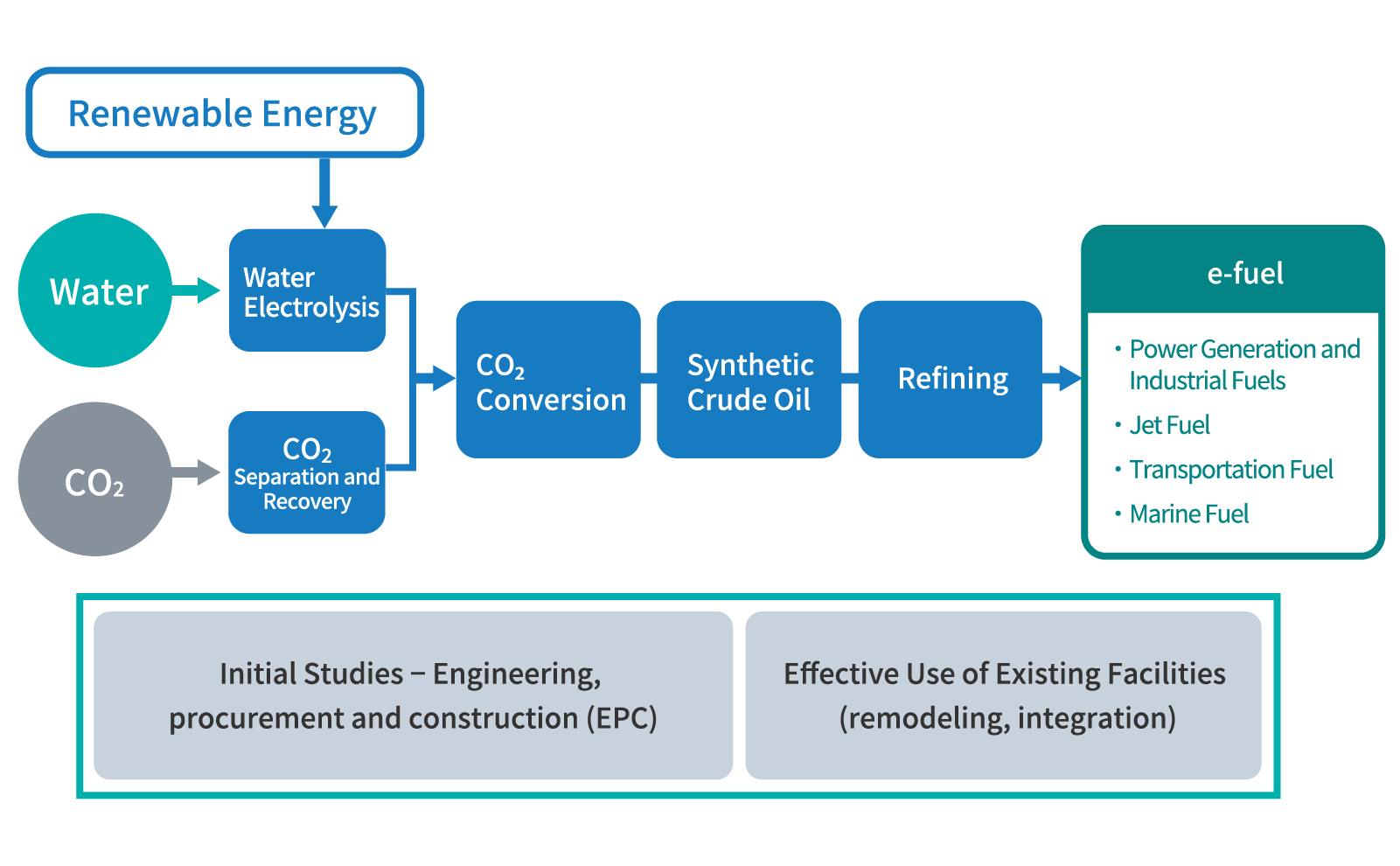
e-fuel is produced from CO2 and hydrogen generated through water electrolysis using renewable energy. With advantages such as compatibility with existing infrastructure, e-fuel is expected to play a key role as a next-generation fuel, replacing conventional fuels such as methane, gasoline, diesel, and jet fuel, and contributing to carbon neutrality.
Characteristic 1
Although CO2 is emitted during combustion, e-fuel reduces overall CO2 emissions by over 70% by reusing the CO2 emitted from power plants, factories or existing in the atmosphere.
Characteristic 2
E-fuel does not contain sulfur or heavy metals compared to crude oil, reducing the risk of health-damaging pollutants such as SOx (sulfur oxides) and NOx (nitrogen oxides) in the exhaust gas.
Characteristic 3
Existing infrastructure, such as petroleum and natural gas supply chains, can be used for distribution and sales.
Chiyoda’s end-to-end solutions from hydrogen production to e-fuel manufacture.
Chiyoda offers end-to-end solutions to support e-fuel commercialization, from hydrogen production to fuel synthesis and purification, including initial feasibility studies, design, procurement, construction and integration of existing facilities for effective utilization. We provide tailored proposals, ranging from small to large-scale operations, that combine the most suitable and cost-effective technologies for our customers business strategy.
[Chiyoda Solutions]
Chiyoda completed a 1 barrel per day (B/D) production test plant aiming for the early establishment of a synthesis fuel production process using hydrogen and CO2 as raw materials and one of the world's largest CO2 methanation test plant.
Chiyoda is also executing an engineering, procurement and construction (EPC) project for a carbon dioxide (CO2) to carbon monoxide (CO) chemical transformation plant.
SAF (Sustainable Aviation Fuel)
SAF is a collective term for sustainable jet fuels used in the aviation sector. It includes fuels produced from feedstocks such as used cooking oil, animal and vegetable fats and oils, biomass, and waste, as well as e-SAF, synthetic fuels derived from e-fuels made using CO2 and green hydrogen.
Characteristic 1
SAF reduces CO2 emissions compared to fossil jet fuels, contribute to the decarbonization of the aviation industry.
Characteristic 2
SAF is compatible with conventional jet fuels* and can be utilized without modifications to existing aircraft engines or refueling infrastructure.
- The maximum blending ratio is subject to the applicable Annex and permitted blending limits specified in ASTM D7566.
Characteristic 3
SAF feedstocks can be sourced domestically, contributing to a stable energy supply.
Chiyoda is carrying out basic design work for several SAF production facility projects to promote the social implementation of SAF.