
Export Control in Chiyoda Group
Export control
From the perspective of maintaining international peace and security, major countries including Japan regulate the export of goods and the provision of technologies through international treaties and export control frameworks (export control regimes). In Japan, such regulations are implemented under the Foreign Exchange and Foreign Trade Act.
In order to fulfill our mission of contributing to the development of a sustainable society, the Chiyoda Group has established 'compliance with international treaties and the laws and regulations of each country related to trade' as part of our Code of Conduct. Based on this principle, we are committed to establishing and operating an appropriate export control system.
Chiyoda has established internal regulations titled 'Security Export Control Program' (Compliance Program), which define our basic policies and procedures for export control, and has filed these regulations with the Ministry of Economy, Trade and Industry (METI). In accordance with these regulations, we conduct export control activities in an organized and continuous manner.
Export Control System
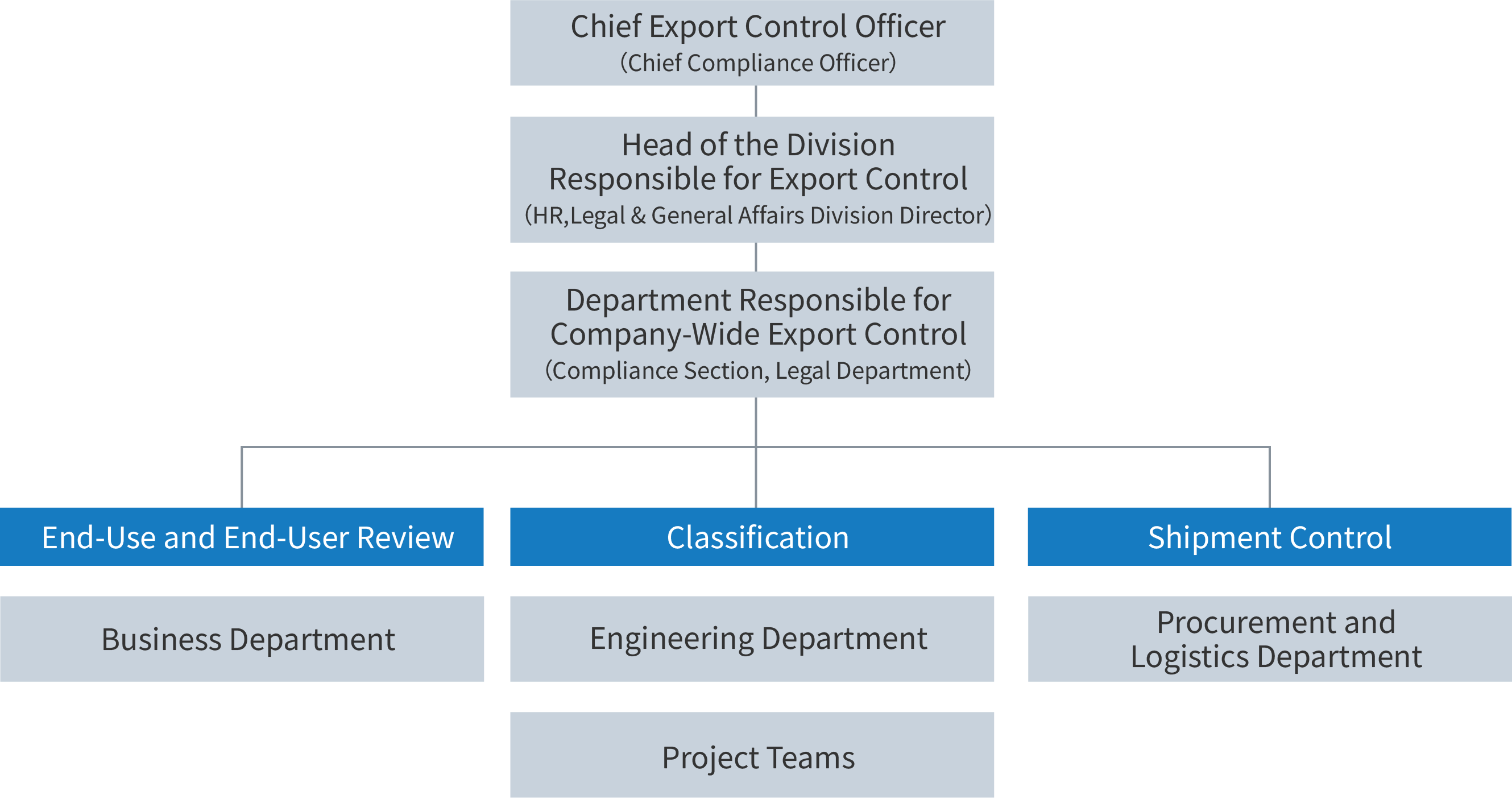
To ensure compliance with export-related laws and regulations and to maintain proper export control, Chiyoda has established an export control system under the ultimate responsibility of the Chief Compliance Officer (Representative Director).
Under this system, the department responsible for export control oversees company-wide export control activities, while the Compliance Section of the Legal Department handles operational aspects. In addition, Compliance Officers (COs) in each department serve as the persons responsible for export control within their respective organizations.
Export Control Procedures
For transactions involving exports, Chiyoda conducts the following reviews to ensure thorough export control:
- Classification (Determination of Applicability)
The project and engineering departments confirm whether the goods or technologies intended for export are subject to regulatory controls under applicable laws. - End-Use and End-User Review
The business department verifies that the goods or technologies will not be used or diverted for military purposes, and that the end-users and destination parties do not pose security concerns. - Transaction Screening
Based on the results of the above reviews, the department responsible for export control determines whether there are any security concerns associated with the export transaction. Where approval from the Minister of Economy, Trade and Industry is required, the necessary application for export permission is submitted. - Shipment Control
The procurement and logistics departments ensure that the goods or technologies being exported or provided are consistent with those approved through the review process.
Education and Training
Chiyoda provides systematic and ongoing training to ensure the proper implementation of export control.
All officers and employees receive basic training covering international security environments, an overview of export-related laws and regulations, as well as the company's export control system and internal rules.
Additionally, specialized practical training--such as classification and export licensing procedures--is provided to employees engaged in export control operations, including both technical and administrative personnel, to enhance their expertise.
Document Management
Chiyoda properly retains and manages all documents and records related to export control in accordance with applicable laws and regulations.
Internal Audit
The Compliance Section conducts internal audits once a year to verify that security export control is being appropriately implemented in accordance with internal regulations.
These audits confirm the operational status of export control within each department and, where necessary, provide instructions for improvement to strengthen the system on an ongoing basis.
Audits are also conducted for Chiyoda Group, with guidance and corrective actions provided as needed.