








Expanding Industry Transformation, Starting with Internal Self-transformation
── Can you please explain the overarching vision of the Chiyoda DX Initiative?
Furuichi
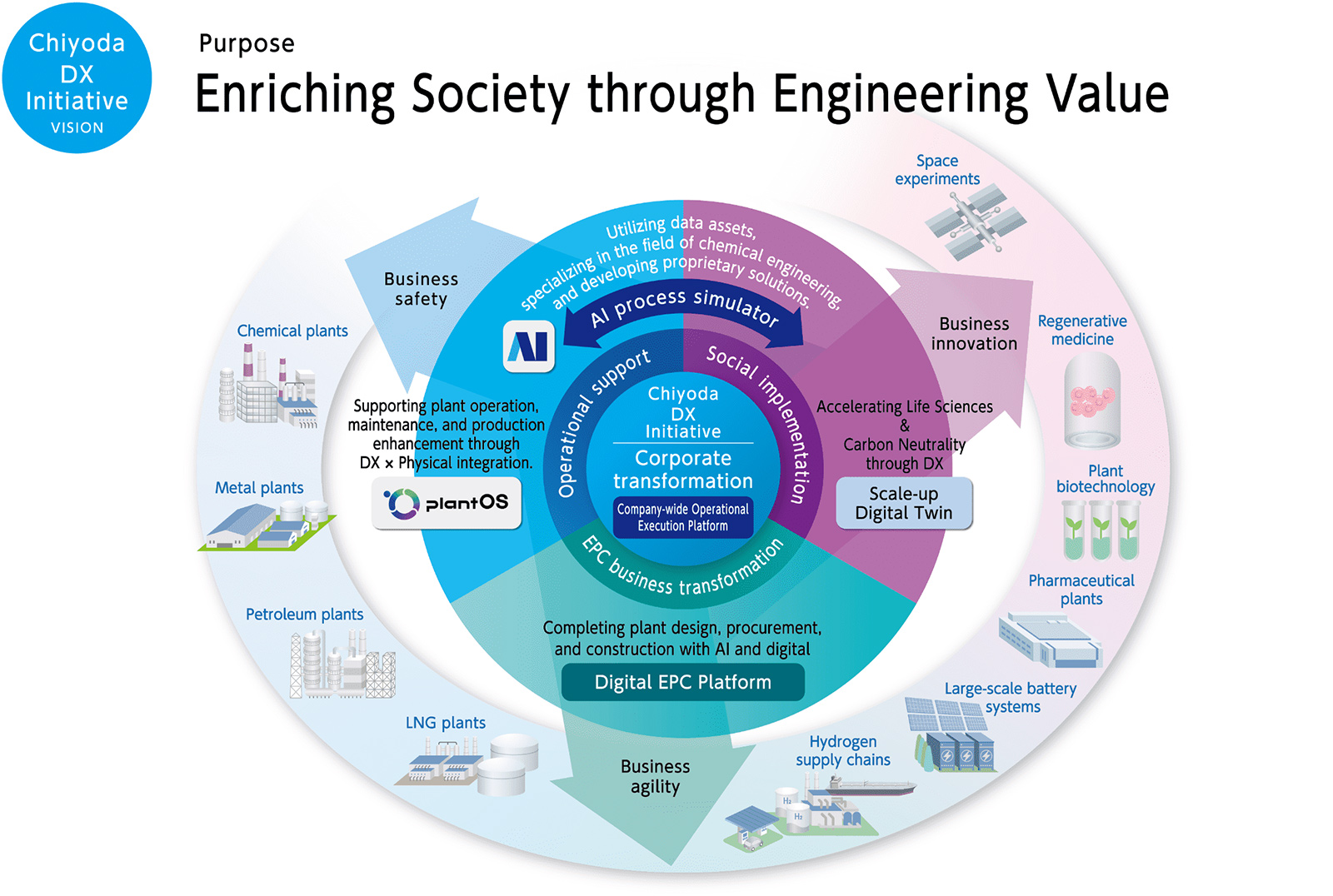
The vision of the Chiyoda DX Initiative is to drive self-transformation and industry transformation through DX, while ‘Enriching Society through Engineering Value’. This initiative represents a systematic framework built on previous company-wide DX efforts, with its core ‘Company-wide Operational Execution Platform’ serving as the foundation for internal self-transformation.
This platform integrates project execution, back-office management and information sharing with external partners, enabling the company to share constantly updated and structured data across the organization. The platform thus facilitates self-transformation, enhancing areas such as corporate governance, risk management and individual employee performance.
The platform also leverages accumulated data and knowledge to drive industry transformation across three collaborative domains: EPC Business Transformation, Operational Support and Societal Implementation. The platform also employs core AI technology, the AI Process Simulator, to accelerate these efforts and promote the co-creation of societal value.

── How is ‘Industry Transformation Support’ being advanced?
Furuichi
Our approach aligns with three strategies: EPC Business Transformation, Operational Support and Societal Implementation, as outlined in ‘Management Plan 2025’.
- 1. EPC Business Transformation:
We aim to enhance Business Agility*1 by completing the processes of plant Engineering (E), Procurement (P), and Construction (C) using the ‘Digital EPC Platform’, which integrates AI and digital technologies. - 2. Operational Support:
By leveraging DX, engineering expertise and physical solutions, we support plant owners in areas such as operations, maintenance and production optimization. This is achieved through ‘plantOSTM’ *2, contributing to the realization of Business Safety*3 by ensuring stable and secure business activities. - 3. Societal Implementation:
In new fields such as life sciences and carbon neutrality, we foster Business Innovation by utilizing DX-driven solutions, such as the ‘Scale-up Digital Twin’.
Both Operational Support and Societal Implementation are also propelled by our proprietary AI Process Simulator, which is specifically designed for applications in chemical engineering. This technology serves as a crucial engine for advancing these initiatives, utilizing our extensive data assets to amplify impact and efficiency.
- 1:The ability to respond quickly and flexibly to changes in external environments, such as market demands, customer needs or technological advancements, ensuring sustained growth and competitive advantage.
- 2:A digital solution platform that supports plant operations and maintenance.
- 3:Safe and secure corporate activities which ensure business sustainability and flexibly adapt to environmental and societal changes.

Driving Self-transformation with Bottom-up and Top-down Approaches
── To drive DX, the presence of individuals who can lead transformation at each site is key. Can you please share your endeavors in talent development?
Shincho
Our company has developed a strong pool of talent to lead DX initiatives. We currently have 20 employees certified with the ‘E Qualification’*4 from the Japan Deep Learning Association (JDLA), which validates expertise in deep learning. Many DX core personnel have also been cultivated through internal training programs across departments. These DX core individuals also play an essential role in promoting ‘Citizen Development’, where employees engage in operational improvement activities.
- 4:Certification for AI engineers, verifying advanced knowledge and skills in deep learning.
── What does citizen development entail and is it open to all employees?
Shincho
Citizen development empowers non-IT personnel and on-site employees to create and improve business applications and automation tools using no-code and low-code tools*5. Participation is open to every employee, with user-friendly development apps provided, weekly consultation sessions and support through internal communication platforms where users assist each other. Over 100 employees have embarked on DX initiatives to date, collectively saving over 20,000 hours of operational time.
However, while citizen development generates data and systems at the local level, it often falls short of enabling cross-departmental or project-wide integration for company-wide utilization. To address this, we are simultaneously implementing top-down strategies such as the Company-wide Operational Execution Platform and Digital EPC Platform, ensuring localized improvements can be leveraged across the entire organization.
- 5:User-friendly platforms that allow application development with minimal or no programming expertise.
── Can you please elaborate on the ‘Company-wide Operational Execution Platform’ and its development progress?
Shincho
The Company-wide Operational Execution Platform consists of two major systems: project-side systems and corporate-side systems.
- • Project-side Systems:
These systems support the seamless execution of our core EPC projects, including comprehensive schedule management, diagram management and procurement control for equipment and materials. While many tools are already in use, the next step involves interlinking them to further streamline information flow and enhance project efficiency. - • Corporate-side Systems:
On the corporate side, systems such as resource management, talent management and ERP*6 are operational. These systems play a vital role in supporting project execution and need to be linked with project-side systems for data sharing. The goal is to create a unified Company-wide Operational Execution Platform, connecting databases across both systems. Preparations for data integration are currently underway.
The Digital EPC Platform is also designed for external use, enabling customers and external partners to collaborate securely. To ensure robust security, the platform adheres to international standards for information security frameworks, undergoes regular third-party evaluations and implements comprehensive measures to strengthen protection.
By leveraging both bottom-up and top-down approaches, we aim to maximize the impact of DX across the organization.
- 6:A system for centralizing and optimizing key business processes such as accounting, HR, production, logistics and sales.

Reforming EPC Operations: Engaging External Partners and Sharing Unified Data
── Can you please elaborate on ‘Industry Transformation Support’? Does ‘EPC Business Transformation’ involve extending the use of the Digital EPC Platform to external partners?
Konno
Exactly. The ‘Supply Chain Collaboration Platform (SCCP)’ is an example of such integration, enabling the management of supply chain data, including procurement, process scheduling, transportation and inventory management, while involving external partners. SCCP is already in operation, facilitating collaborative workflows with external stakeholders.
For instance, during the equipment procurement process, after our purchasing department places an order, the equipment manufacturer submits drawings and documents that are reviewed and approved by our engineers. Once approved, the manufacturer begins production and inspections are conducted at key points, with our inspection and quality control personnel present. After passing performance tests and packaging, the equipment is transported by our logistics team to the plant site. For overseas projects, this often involves securing shipping space well in advance, with arrival timing coordinated with our construction team.
These processes previously relied heavily on email exchange for information validation, which was time-consuming and prone to inconsistencies in data accuracy and timeliness. With SCCP, all stakeholders, from manufacturers to shipping companies, can access the same data in real-time, minimizing miscommunication and enabling faster, more accurate decision-making.
From a project perspective, it is equally important to share progress updates, changes and estimated arrival times on a unified data platform with joint venture partners and major subcontractors. By ensuring that all parties have access to relevant information, bottlenecks caused by ‘waiting for confirmation’ during adjustments or modifications can be avoided, significantly improving the speed and accuracy of project-wide decision-making.
── This approach seems to simultaneously enhance operational efficiency and project management sophistication.
Konno
Precisely. By ensuring ’data visibility’ for all parties, even unexpected changes like design modifications can be addressed promptly. We refer to this capability as ‘Business Agility’.
Leveraging historical data further elevates Business Agility. For example, using project management systems to access insights such as ‘actions required and common pitfalls during similar design changes’, and ‘customer-specific communication considerations’ ensures comprehensive responses without omissions. This approach shifts reliance away from veteran engineers' intuition and experience, making these insights reproducible through digital tools instead.