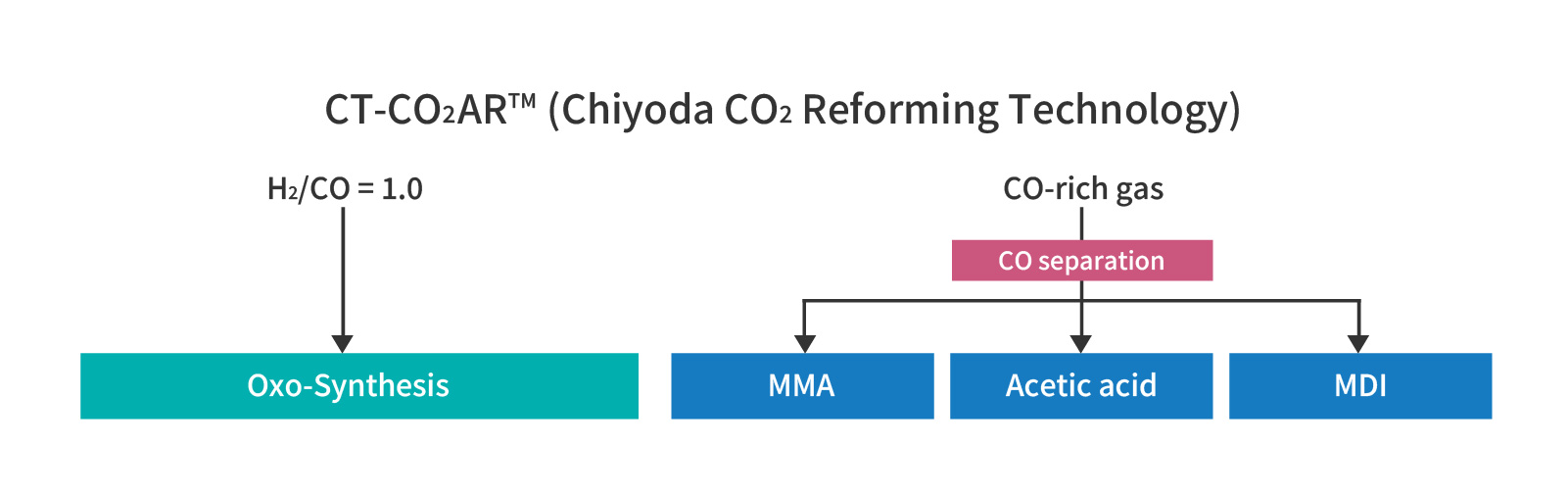
CO2 Reforming Process
CT-CO2ARTM (Chiyoda CO2 Reforming Technology)
CT-CO2ARTM is a unique and advanced technology utilizing CO2 as a reforming agent to efficiently produce synthetic gases of varying H2/CO ratios
This technology enables the monetization of low-calorie, CO2-containing natural gas fields and can also enable the efficient reuse of CO2 emitted from various industrial processes.
Synthesis gases are the feeds for producing various chemicals (Oxo-Synthesis, MMA, Acetic acid, etc.).
The CT-CO2ARTM technology consumes CO2 as a reforming agent and in tandem with its unique reforming catalyst, achieves high energy-efficiency. CT-CO2ARTM is thus, an environmentally-friendly technology due to significant reduction in emissions.
We express our gratitude to the Japan Organization for Metals and Energy Security, JOGMEC, for their support in this technological development.
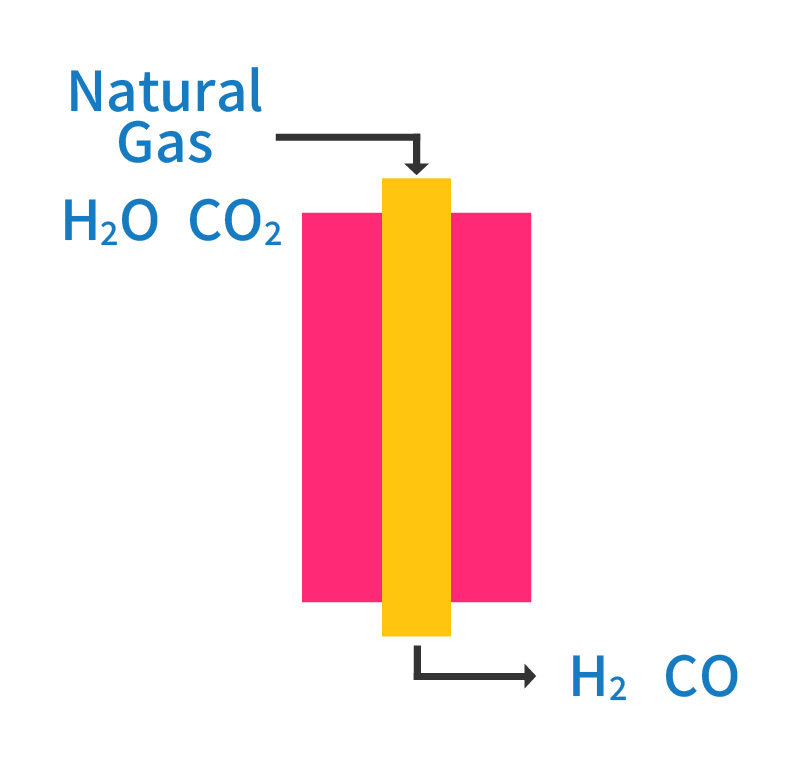
Capabilities
Synthesis gas production under optimum conditions with a novel catalyst
Chiyoda’s proprietary catalyst, having high resistance to carbon formation (even under CO2 reforming conditions), results in significant reductions in the requirement of steam and CO2. Consequently, CT-CO2ARTM produces synthesis gases with high energy-efficiency and without any carbon formation.
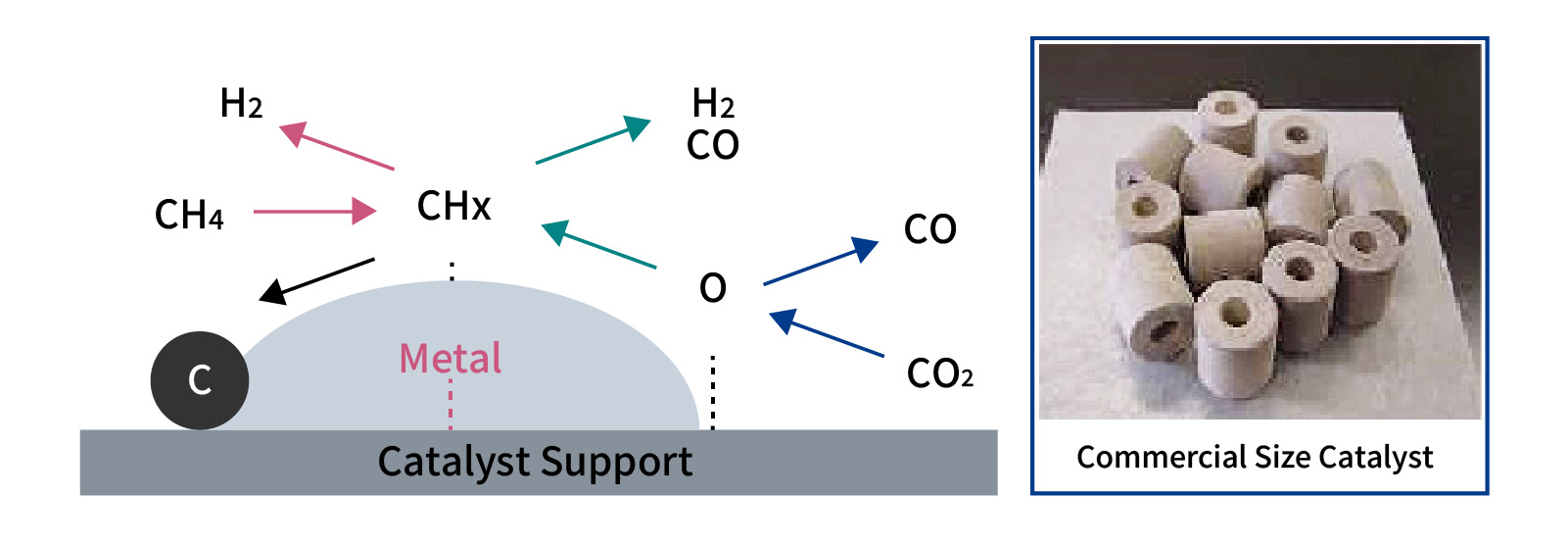
High energy-efficiency and cost competitiveness
Compared to conventional steam-reforming, CT-CO2ARTM reduces the volume of reformer feed gas by 60%. This results in improved energy efficiency together with a significant reduction of capital investment, operating costs and CO2 emissions. Specifically, for production of syngas with an H2/CO ratio of 1.0, capital costs are reduced by more than 20% compared with conventional technologies. For an H2/CO ratio of 0.5, the reduction is even more significant, exceeding 40%. CT-CO2ARTM is thus economically competitive.
Applicable range
Direct production of Synthesis gases with a wide range of H2/CO ratios
Direct production of synthesis gases with a wide range of H2/CO ratios is efficiently accomplished using CT-CO2ARTM, by varying the feed gas ratios such as steam/carbon ratio and CO2/carbon ratio.